

MADRID / 12 December 2025
The Healthy Architecture & City (HAC) research group from the University of Seville has strengthened its close collaboration with the State Reference Centre for Personal Autonomy and Technical Aids (CEAPAT-IMSERSO) in Madrid. The team contributed its proven expertise to the Specialised Training Seminar “Cognitive accessibility and architectural design”, a key event for knowledge transfer in the field of inclusion and the built environment.
The participation of the HAC group took shape through the paper entitled “Healthy architecture for people with Alzheimer’s: Criteria and design guidelines for adapted environments”, which was delivered by Pablo J. Valero Flores, researcher and member of the VIVAlz research project team.
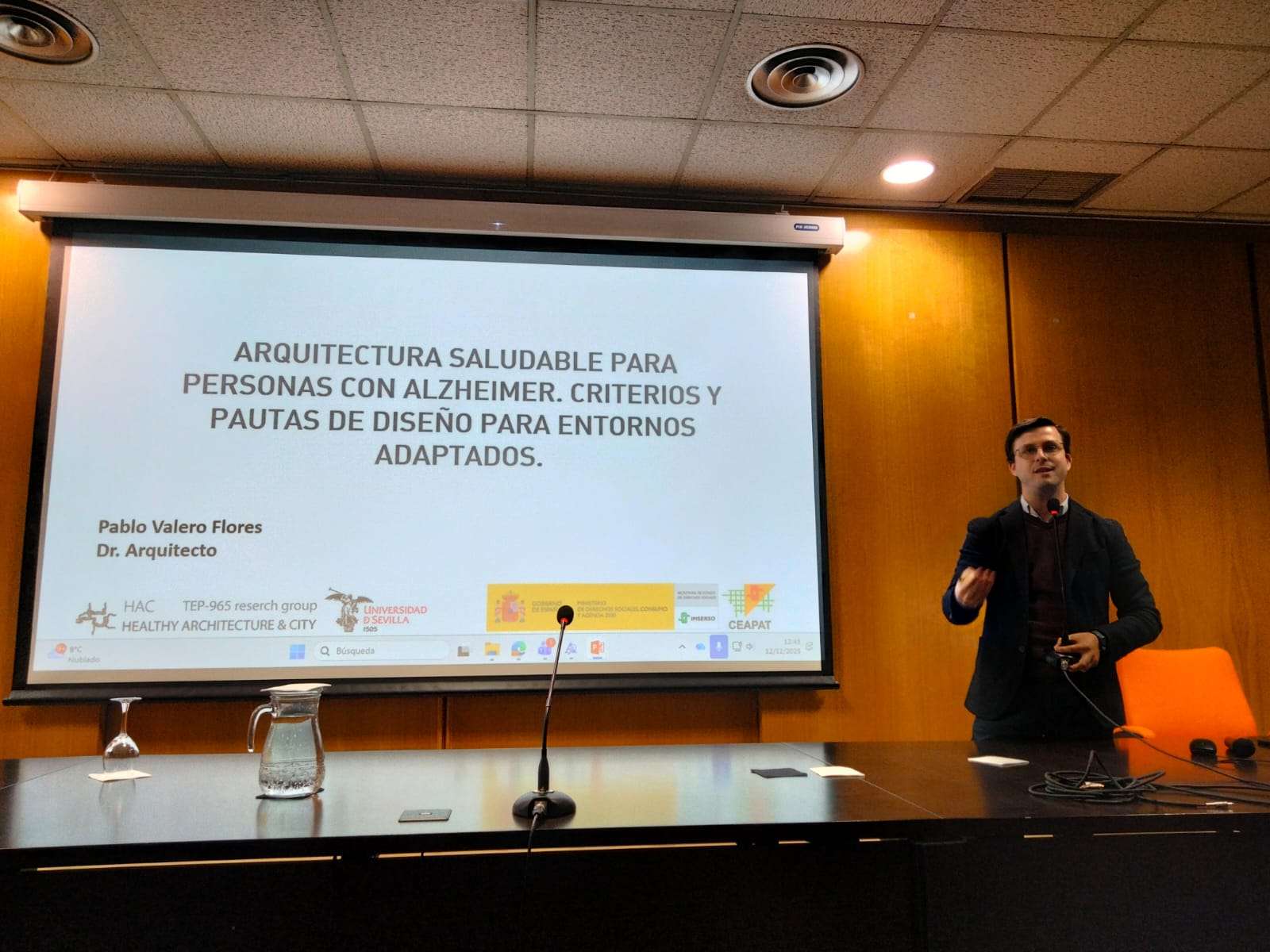
Pablo J. Valero during his address at the CEAPAT (IMSERSO) training seminar
Contemporary architecture and cognitive accessibility
During the presentation, an in-depth examination was conducted on how the fundamental principles of cognitive accessibility can—and should—be directly applied to contemporary architectural design.
The core of the address focused on setting out technical criteria and specific design guidelines for residential spaces. These solutions seek to provide a direct architectural response that promotes orientation, safety, and daily well-being for those living with Alzheimer’s disease and their cohabitants. The ultimate aim of these adapted environments is to substantially enhance users’ quality of life within their own homes, whilst offering essential support for the complex work undertaken by their carers.
These architectural guidelines and criteria form part of the findings emerging from the VIVAlz project, an initiative funded by the Regional Ministry of Development, Territorial Articulation and Housing of the Regional Government of Andalusia (Junta de Andalucía).
Further information:
- Organising body: CEAPAT – IMSERSO; event held at: Specialist Training Workshop – CEAPAT