


Gasification plants
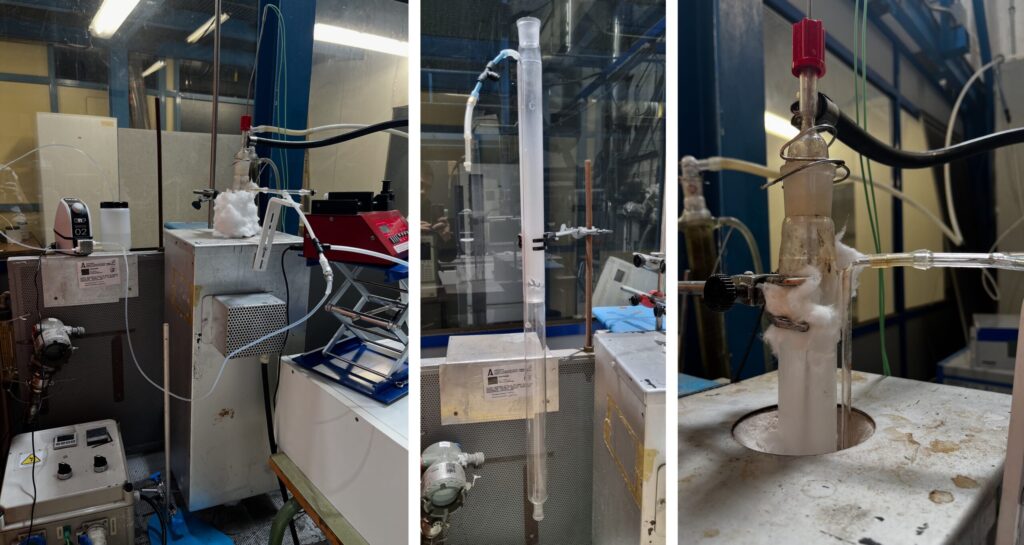
Quartz fluidized-bed reactor
The quartz reactor is designed for small-scale batch testing, allowing better control of process variables and complete recovery of the solid material after the process for analysis. The reactor is made of quartz, a chemically inert material at high temperatures, and measures 740 mm in length with an internal diameter of 32 mm. It has a porous plate in the middle section to support a bed of solids, either fixed or fluidized. It allows feeding a mixture of different gases, having also an auxiliary inlet to feed controlled flows of liquids (such as water or tars) facilitating their vaporization before entering the reaction zone. Ancillary equipment includes an electric furnace, a condensation unit and the liquid feeding system. The outlet gas is sampled continuously to measure CO, CO2, CH4, and H₂ concentrations. All measurements are collected by a data acquisition card connected to a PC.
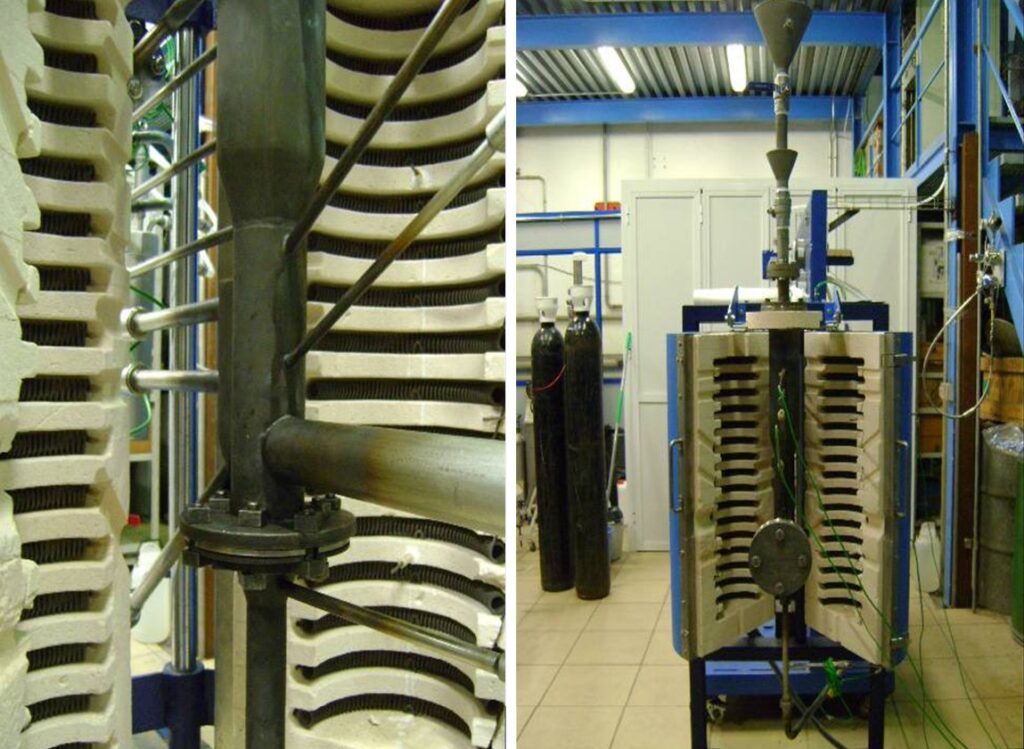
3 kWth laboratory fluidized bed plant
The reactor is a bubbling fluidized bed with a diameter of 51 mm and a nominal capacity of 0.7–1.0 kg/h. The plant is designed for both continuous and batch feeding of solid fuels tests. It allows for the use of mixtures of different gases (steam, air, oxygen, nitrogen, CO₂, H₂, etc.) as fluidizing agent. In the freeboard zone, there are three secondary gas inlets. Solids can be withdrawn from the bed at two heights, discontinuously, through two overflows.
The reactor is equipped with a furnace that allows independent temperature control of both the fluidized bed and the freeboard zones, as well as a preheater for the gas mixture used as the fluidizing agent. Gas inlet flow rates are adjusted using mass flow controllers, including those for gases introduced at the reactor base and for secondary air inlets.
The continuous feeding system consists of a hopper, a dosing screw, and a fast-feed screw. The top feeding system allows for batch feeding of granular fuels or pellets. At the end of the outlet line, there is a gas analyser that continuously measures CO, CO₂, CH₄, and H₂. An Agilent 3000A micro-GC with two channels is also available, providing discontinuous gas analysis (one sample every 5 minutes) for other gaseous species. The plant is designed to allow sampling of gas, tars, inorganic contaminants, and particulate matter. It is also equipped with a basic gas cleaning system consisting of a cyclone, water and biodiesel bubblers, and filters.
All measurements are collected by a data acquisition card via a PLC.
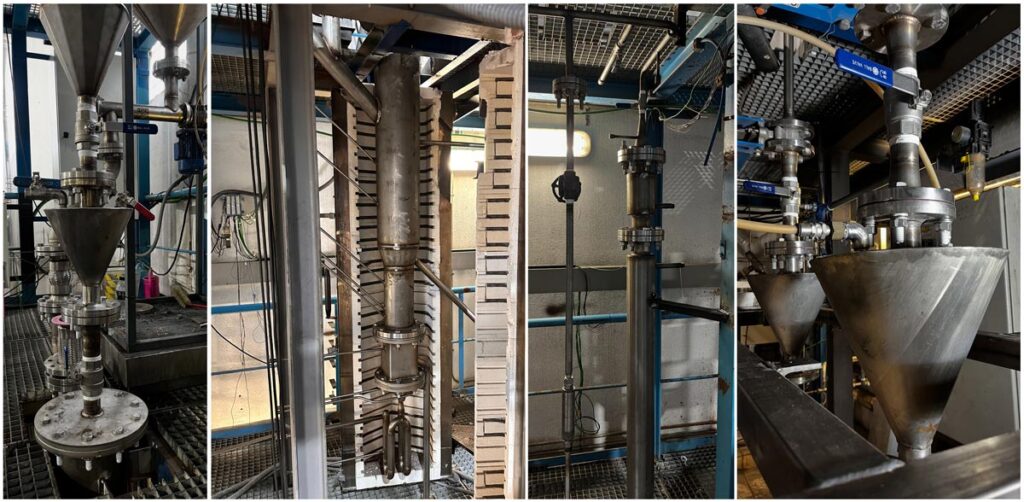
20 kWth fluidized bed pilot plant
The reactor is a bubbling fluidized bed with an inner diameter of 190 mm and a processing capacity ranging from 2 to 5 kg/h of fuel. The plant is designed for continuous gasification tests simulating industrial conditions. Its design allows for the feeding of different solid streams (fuel, catalyst, CO2 sorbent, etc…) using, for this purpose, different solid feeders. Mixtures of different gases (steam, air, oxygen, nitrogen, CO2, etc…) can be used as fluidizing (and gasifying) agent. The inlet gas flow rates are adjusted by means of mass flow controllers, while the steam flow rate is controlled by using a peristaltic pump. An overflow allows for the continuous removal of material from the top of the bed while a loop-seal, placed in the wind box, allows the removal of solids from the lower part of the bed.
The syngas outlet line has a gas purification system consisting of a cyclone, a tar absorption column and various filters to remove particles or condensates. At the end of the outlet line, a gas analyzer continuously measures CO, CO₂, CH₄, and H₂ concentrations. Additionally, an Agilent 3000A micro-GC with two channels analyses the gas discontinuously (one sample every 5 minutes) to measure other gaseous species. The plant is designed to be able to sample gas, tars, inorganic contaminant species and particulate matter. All measurements are collected on a data acquisition card through a PLC.
Catalyst testing laboratory
The Catalyst Testing Laboratory is specifically equipped to carry out heterogeneous catalytic reactions under high-pressure conditions. The facility is configured to allow the use of both gaseous and liquid reactants, enabling the study of a wide variety of reactions. The laboratory houses a total of four lab-scale reactors, including three fixed-bed tubular reactors and one high-pressure slurry (three-phase) reactor.
To date, the Catalyst Testing Laboratory has been used to investigate the following catalytic reactions: ethanol synthesis using oxo-type catalysts, hydrodesulfurization, modified methanol and Fischer-Tropsch synthesis, methyl acetate hydrogenation, dimethyl ether carbonylation, synthesis of butanol and butadiene from ethanol, and steam methane reforming.
The main applications of the laboratory in the study of these catalytic reactions have included:
- Catalyst screening for performance evaluation
- Optimization of operating conditions for selected catalysts
- Long-term testing to determine catalyst stability
- Kinetic modeling and determination of reaction mechanisms
The primary equipment available in the laboratory includes:
High-pressure fixed-bed reactors
Reactor HP1
This system consists of a 310 stainless steel fixed-bed tubular reactor, with an outer diameter of 0.9 cm and a length of 33 cm, capable of operating at pressures up to 100 bar. Stainless steel 310 can withstand temperatures of up to 1100 °C and exhibits excellent resistance in chemically aggressive environments, such as those involving alcohols and organic acids. Temperature control is achieved through a furnace capable of reaching 800 °C and an air-cooling system.
Reactor HP2
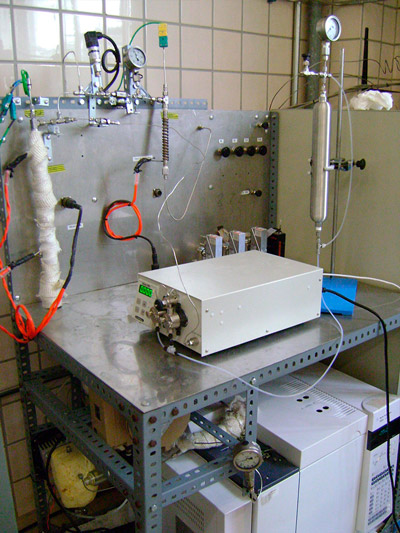
This system consists of a 304 stainless steel fixed-bed tubular reactor, with an outer diameter of 0.9 cm and a length of 32.5 cm, capable of operating at pressures up to 200 bar. Temperature control and measurement are performed via two heating elements wrapped around the reactor and a thermocouple that monitors axial temperature at three different points along the reactor.
Reactor HP3
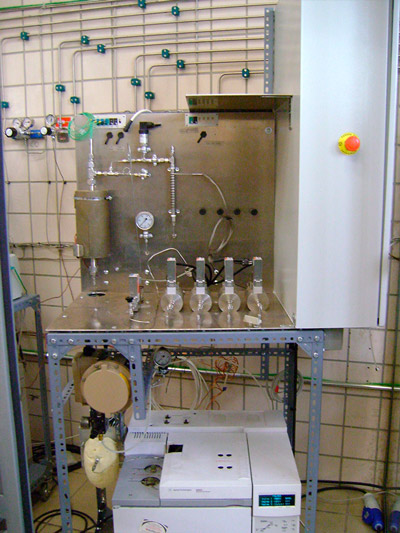
This system consists of a 310 stainless steel fixed-bed tubular reactor, with an outer diameter of 1.8 cm and a length of 33 cm, capable of operating at pressures up to 200 bar. Stainless steel 310 withstands temperatures up to 1100 °C and is highly resistant to corrosive chemical environments. Temperature control is provided by a furnace capable of reaching 1100 °C.
High-Pressure Three-Phase (Slurry) Reactor
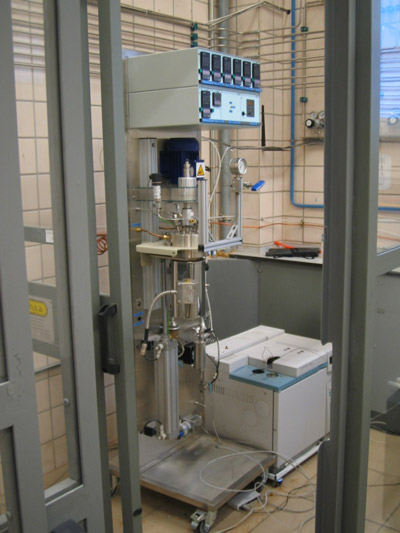
This reactor consists of a 1-liter vessel supplied by Autoclave Engineers, made of 316 stainless steel, and equipped with a turbine agitator, capable of operating at pressures up to 250 bar. The catalyst is suspended in a liquid phase (slurry). The liquid is typically a heavy hydrocarbon, selected to avoid evaporation at reaction temperatures. Syngas is bubbled through the liquid phase. The slurry is cooled via a coil-type heat exchanger immersed in the reactor bed, with water circulation.
Key advantages of this type of reactor include: High heat transfer efficiency, enabling precise control of reaction temperature, and the ability to reload the slurry with fresh catalyst during operation
Analytical equipment
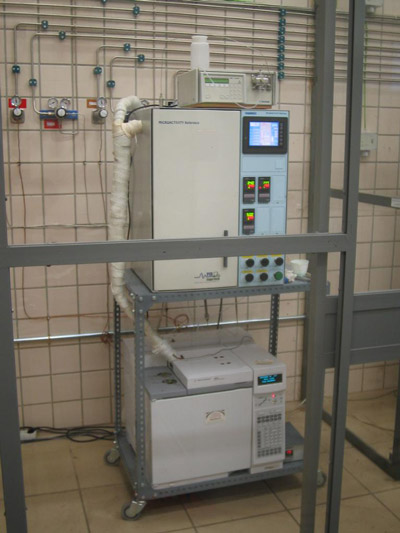
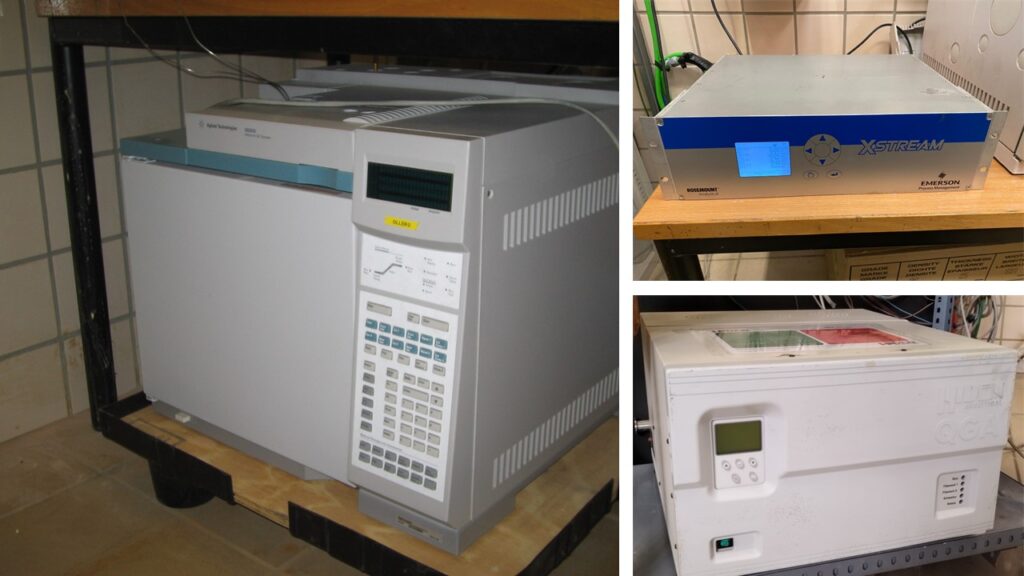
Each reactor is connected to a dedicated analytical system. The Catalytic Synthesis Laboratory is equipped with several Agilent 6890N and 7890N Network GC Systems, a Hiden Analytical QGA mass spectrometer, and an Emerson X-Stream XE gas analyzer.
Agilent Gas Chromatograph System
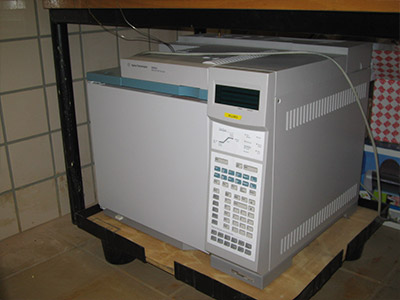
GC-6890 systems are equipped with dual injectors, two packed columns, one capillary column, a thermal conductivity detector (TCD), and a flame ionization detector (FID). The GC-7890 systems also feature dual injectors, five capillary columns, one TCD, and two FIDs.
Hiden Mass Spectrometer
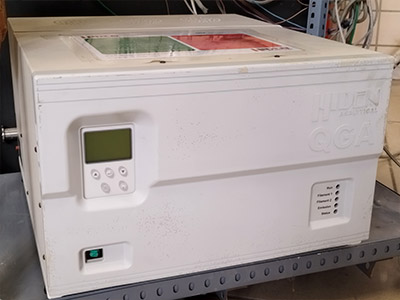
The Hiden Analytical QGA mass spectrometer enables continuous analysis of multiple gaseous components via quadrupole mass spectrometry. Designed for real-time gas quantification, the system offers high sensitivity across a wide range of species, including light gases such as hydrogen (H₂) and helium (He), as well as heavier compounds like carbon dioxide (CO₂), carbon monoxide (CO), methane (CH₄), and ammonia (NH₃). The QGA uses electron impact ionization and a quadrupole analyzer to separate ions by their mass-to-charge ratio (m/z), enabling simultaneous and precise analysis of multiple gases, even in complex mixtures.
Emerson Gas Analyzer
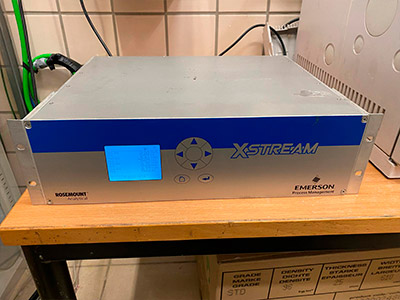
The Emerson X-Stream XE gas analyzer, model XEGP-IR IR IR TC, allows for continuous analysis of up to four gas components, combining thermal conductivity (TC) and infrared (IR) detectors. This enables the simultaneous measurement of different gas components, including those poorly detected by IR alone, such as hydrogen (H₂). IR detectors are typically used to quantify carbon monoxide (CO), carbon dioxide (CO₂), and methane (CH₄), while the TC detector is used for hydrogen (H₂) analysis.