Benchmarking urban morphology by Reviewing Adaptive Comfort and Thermal Stress (REACTS)
Objetives
The coordinated REACTS project (Benchmarking urban morphology by Reviewing Adaptive Comfort and Thermal Stress) addresses the vulnerability of Mediterranean cities, such as Seville, to thermal stress exacerbated by climate change and the Urban Heat Island (UHI) effect.
The central objective is to design and validate an advanced predictive model, based on Machine Learning (ML), enabling the multidimensional and integrated assessment of Outdoor Thermal Comfort (OTC). Distinct from conventional physiological models (PET, UTCI), UTHECA’s approach lies in solving the complexities inherent in modeling OTC as a complex system by integrating the crucial subjective and adaptive perception of users.
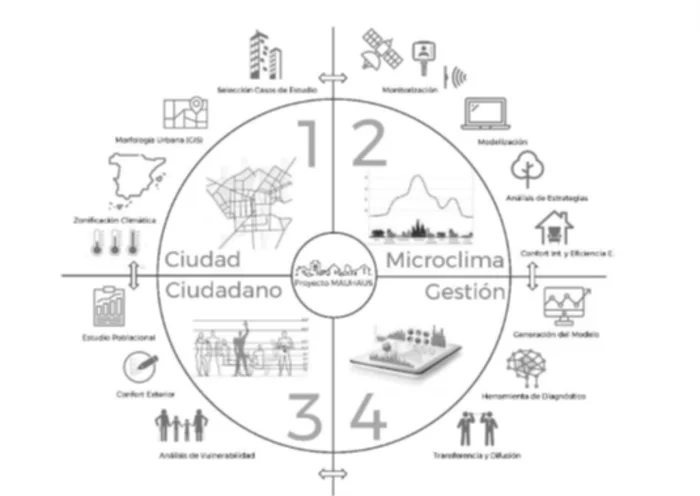
The methodology is structured across multidisciplinary phases. Initially, objective data is collected, including urban morphology analysis (via GIS and IoT microclimatic monitoring) and subjective data via population surveys, utilizing Opinion Mining techniques to classify and quantify adaptive perception. Subsequently, the complex system data is modeled. Subproject 2 designs an Agent-Based System to describe human mobility and behavior and utilizes Topological Data Analysis (TDA) to classify the structure of mobility trajectories. These robust descriptors, combined with microclimatic and subjective data, feed ML models (such as SVR and Neural Networks) to generate accurate OTC predictions. The final output is a recommendation system interface designed to guide public administrations in decision-making regarding urban intervention strategies, leading to more livable and resilient public spaces.
Publications
Other results
UTHECA_USE – Urban Thermal Perception Dataset
Includes 989 observations of 55 variables grouped into three categories: microclimatic variables, personal characteristics, and morphological data of the urban environment.
OTC_Advisor: A Web Application for Outdoor Thermal Comfort Classification and Visualization.
An interactive application developed in R Shiny aimed at evaluating and visualizing thermal comfort in urban outdoor spaces.
ArchiData: R package for architectural analysis.
Provides a suite of functions for analyzing and visualizing various aspects of architectural design, such as building dimensions, room layouts, and facade features.
Dissemination
Modern Movement Urbanism and Climate Adaptability: a Dual Neighbourhood Case Study in South Europe
19th SDEWES. Conference on Sustainable Development of Energy, Water, and Environment Systems. Roma, Italy. September 8-12, 2024.
Pedestrians’ urban thermal comfort: A machine learning assessment through transect walks
12th SESDE 2024. International Workshop on Simulation for Energy, Sustainable Development and Environment. Tenerife, Spain. September 18-20, 2024.
Funding Entity
Proyect TED2021-129347B-C21 funded by MCIN/AEI/ 10.13039/501100011033 and by the “European Union NextGenerationEU/PRTR”