Rubens and his copies of Titian’s works: Using thread count maps
Speaking of Rubens’s activity during his second visit to Madrid, from September 1628 to April 1629, Francisco Pacheco wrote, ‘It seems incredible that he should have painted so much in so short a time and amidst so many occupations.’ Among the works painted by Rubens in that time, he mentions ‘five or six portraits’ of ‘private individuals’ and claims that he also ‘copied everything by Titian in the king’s possession’. Considering that the Spanish royal collection contained over fifty Titians at the time, it is unlikely that Rubens was able to create full-scale copies of them all.
The Prado owns two of Rubens’s copies of originals by Titian, Adam and Eve and The Rape of Europa, which have been analysed to determine whether they were painted during his stay in Madrid, as Pacheco maintained, or at his home/workshop in Antwerp upon returning from Spain.
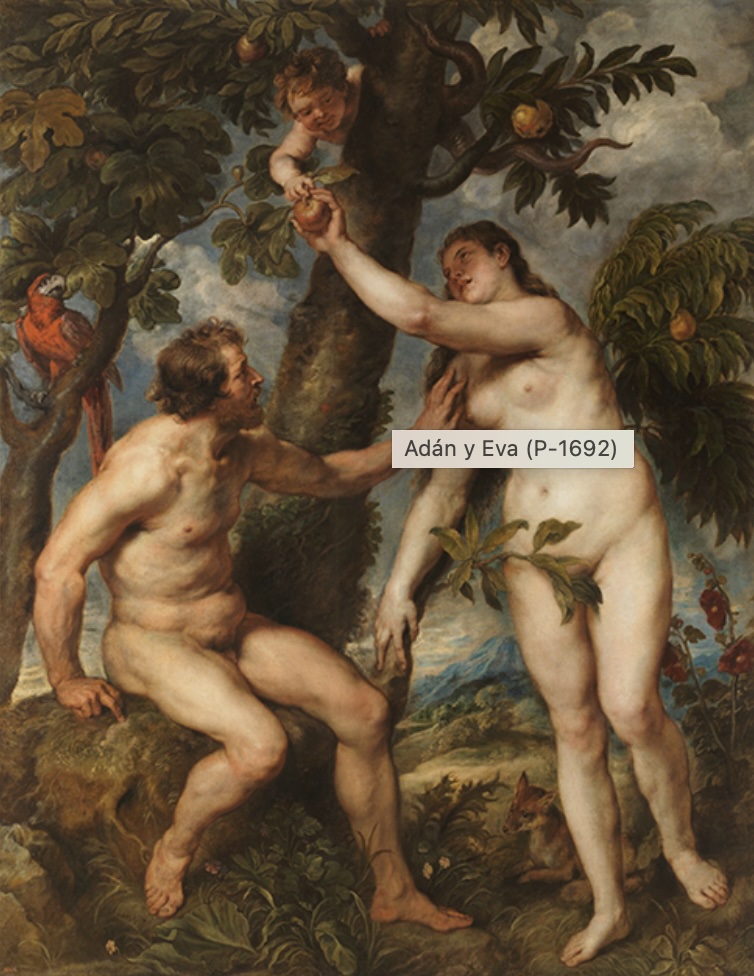
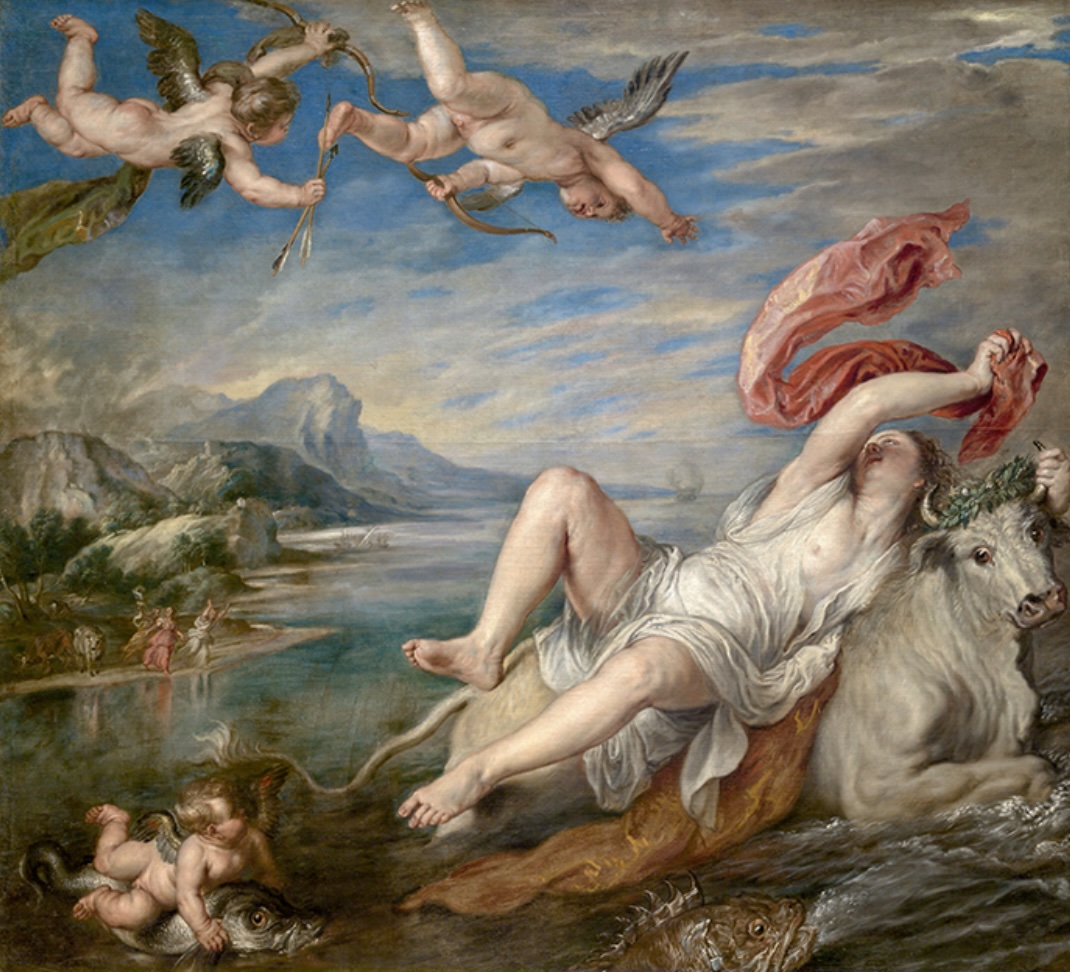
Materials analysis had confirmed that Adam and Eve was painted in Madrid during Rubens’s trip to Spain in 1628. However, the results of tests on The Rape of Europa were inconclusive, and it was decided that Aracne should be used to compare the canvases of both works.
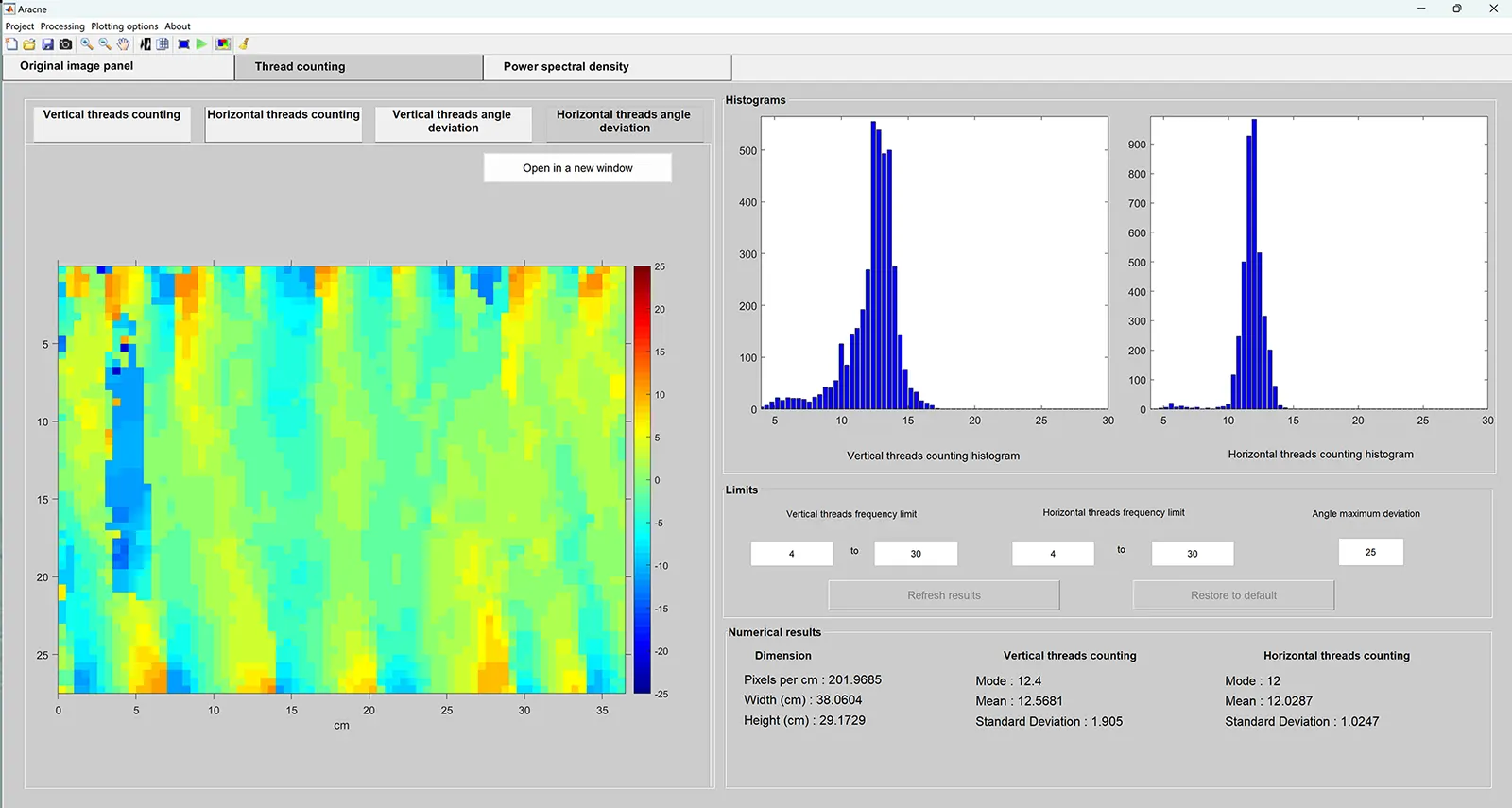
The histograms and thread count maps proved particularly useful in this case, allowing us to prove that the same fabric was used for both paintings, although one is rotated in relation to the other. The fact that the two scenes were painted on two pieces of canvas cut consecutively from the same cloth confirms that Rubens made both in Madrid.
The following image shows the histograms with the vertical (left) and horizontal (right) thread counts of the two works, Adam and Eve above and The Rape of Europa below. The statistical results, mean and mode, of these estimations are displayed to the right of the histograms.
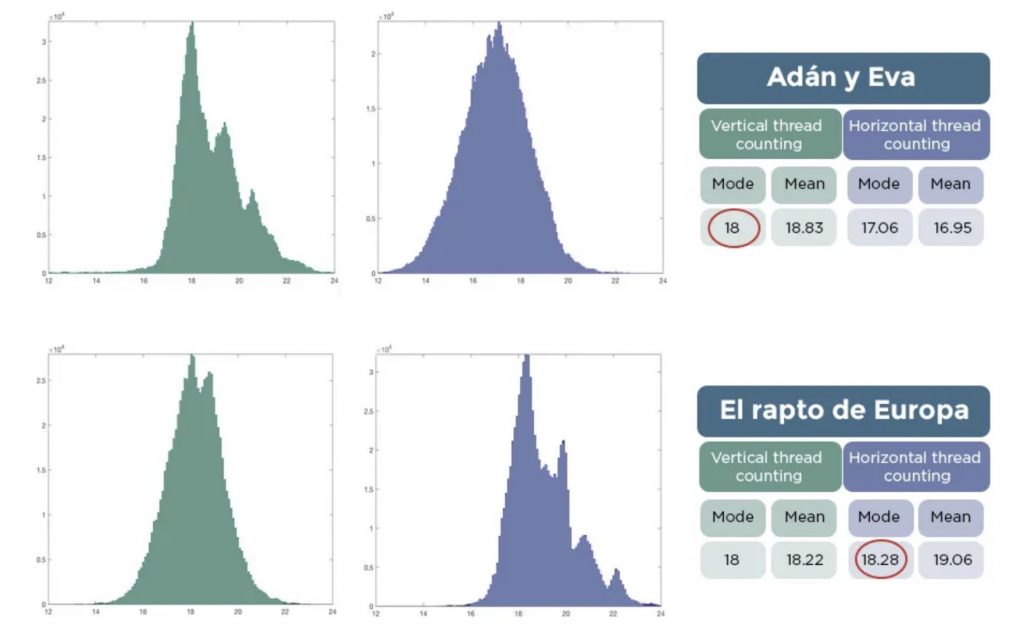
The weft tends to look like a Gaussian curve, because the weaver tenses the thread differently every time it passes from side to side. But the arrangement of the warp is decisive and depends on how the threads are tied onto the loom. The upper left histogram is similar to the lower right one; in both cases, we see concentrations of densities at around three or four, with the highest values being 18 and 18.28, respectively. This tells us that the vertical warp threads in Adam and Eve match the horizontal threads in The Rape of Europa. This coincidence proves that the two fabrics are related, which is also confirmed when we compare the distribution of densities on the thread count maps.
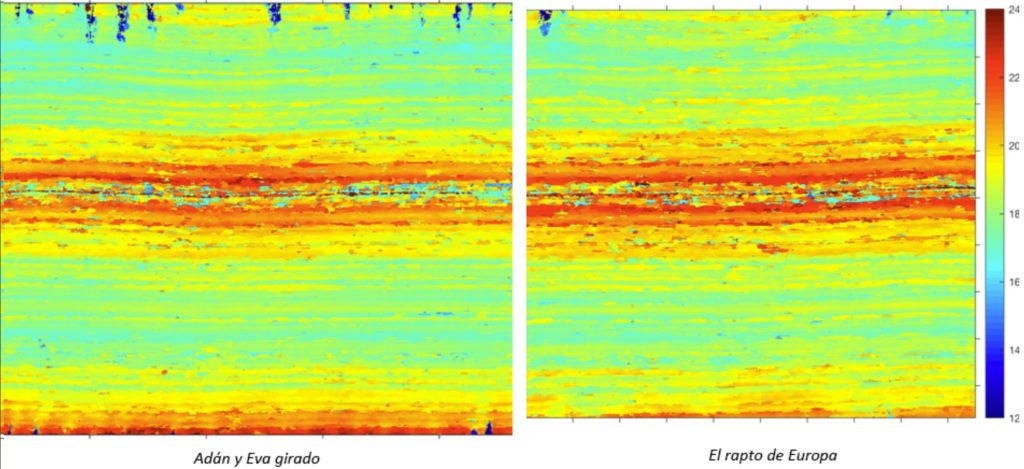
The image shows that thread density matches across the support surface, varying identically along the length of the warp and weft of both paintings, although Adam and Eve is rotated 90º so that its vertical threads align with the horizontal threads in The Rape of Europa. In both cases, we can see that the artist used two pieces of fabric sewn together in the middle. Thread count is higher on the outer edges of the canvas than in the central part.
The results of this study were published in ‘Rubens en Madrid (1628-29): nuevos datos técnicos sobre sus copias de Tiziano y un nuevo retrato‘.
Other Results
- Jover, L. Gayo and L. Alba (2019). ‘Sofonisba Anguissola en el Museo del Prado. Una aproximación a su técnica.’ In Historia de dos pintoras: Sofonisba Anguissola y Lavinia Fontana. Museo Nacional del Prado.
- Alba, L. (2018). ‘El estudio de los soportes textiles a través de la radiografía. Los soportes españoles del siglo XVII.’ In La rivista del restauro 111–112, pp. 143–149.
- Vergara, L. Alba, L. Gayo and M. Jover (2017). ‘La elaboración en dos etapas del Meleagro y Atalanta de Jacob Jordaens en el Museo del Prado. Consideraciones técnicas.’ In Boletín del Museo del Prado 53, pp. 76–82.
- Aterido, A. and L. Alba (2013). ‘Juan Fernández el Labrador, Miguel de Pret y la “construcción” de la naturaleza muerta.’ In Boletín del Museo del Prado 31, p. 34.
- Vergara, A., L. Alba and L. Gayo (2013). ‘Rubens en Madrid (1628-29): nuevos datos técnicos sobre sus copias de Tiziano y un nuevo retrato.’ Boletín del Museo del Prado 31, p. 183.