
The Universities of Seville and Algarve Analyze Risks in Schools in the Province, Especially the Coastal Area, Due to High Seismic Activity
Huelva — Are schools and educational centers prepared to respond in the event of an earthquake? This is the question addressed by research conducted by experts from the Universities of Seville and Algarve (Portugal), who have developed a system to evaluate and reinforce schools against earthquakes using a set of indicators. Based on these, they seek solutions to make these buildings more resistant according to principles of efficiency, cost, and architectural impact. Although the method is designed for schools, it can also be applied to other types of buildings such as homes, high schools, or hospitals.
Using specialized software, the experts analyzed building behavior according to seismic regulations, explains Fundación Descubre in a press release. They obtain data to understand the structural response and the potential damage the building would suffer during an earthquake. The method evaluates how the school’s performance could be improved with different structural reinforcement systems. This information is combined with cost and architectural impact indicators to find the best alternative.
The study focused on schools built in Huelva and the Algarve. “Most of these schools were built during the 1970s. Therefore, seismic requirements were not strict, and in most cases, the designs only considered gravitational loads,” explained lead author María Victoria Requena García de la Cruz, a researcher at the Universidad de Sevilla.
The method was successfully applied to a school in Huelva, with the results and various phases of the system developed by this group of experts published in the journal PLOS ONE under the title “An index-based method for evaluating seismic retrofitting techniques. Application to a reinforced concrete primary school in Huelva.”
“Many schools could benefit from structural reinforcement, so part of the work involved screening which construction solutions best fit our technology, are more cost-effective, and respect the building’s design so it remains functional,” noted co-author Antonio Morales, project lead at the University of Seville for the PERSISTAH project funded by the Interreg-POCTEP program, under which this research falls.
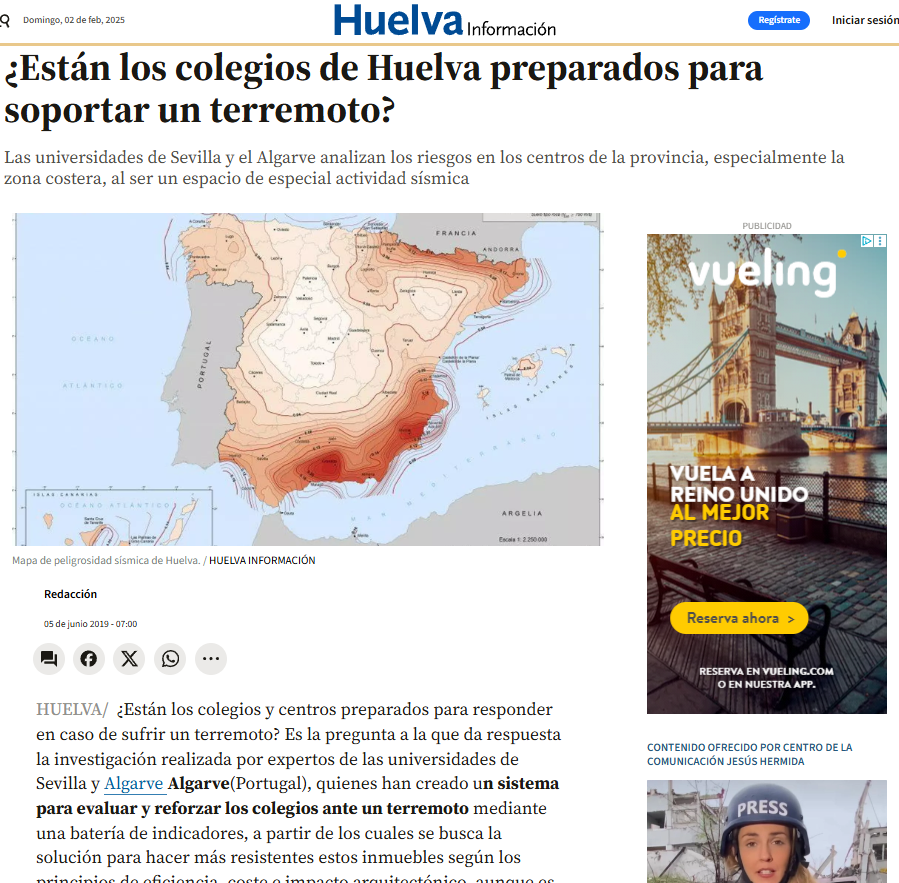
The regions of Huelva and the Algarve are characterized by considerable earthquake activity, as with other parts of Andalusia identified on Spain’s seismic hazard map, due to their proximity to the Gibraltar-Azores fault, where the Eurasian and African tectonic plates meet. Exposure to earthquakes can be worsened depending on the soil type where a building is located.
“In Huelva’s case, being near the coast and marshlands, it is characterized by soft soils, which amplify the effects of seismic activity,” María Victoria Requena explained.
Additionally, primary schools in both regions share common seismic vulnerabilities. The oldest schools, dating from the 1960s, were built with load-bearing walls, featuring a high percentage of openings and low-quality materials.
Others are constructed with shorter-than-usual pillars and reinforced concrete beams. The ground floors tend to be weaker as they lack enclosing walls and do not rest directly on the ground but rather on an insulating layer — a construction method known as “sanitary slab.”
Access to the complete article here.