
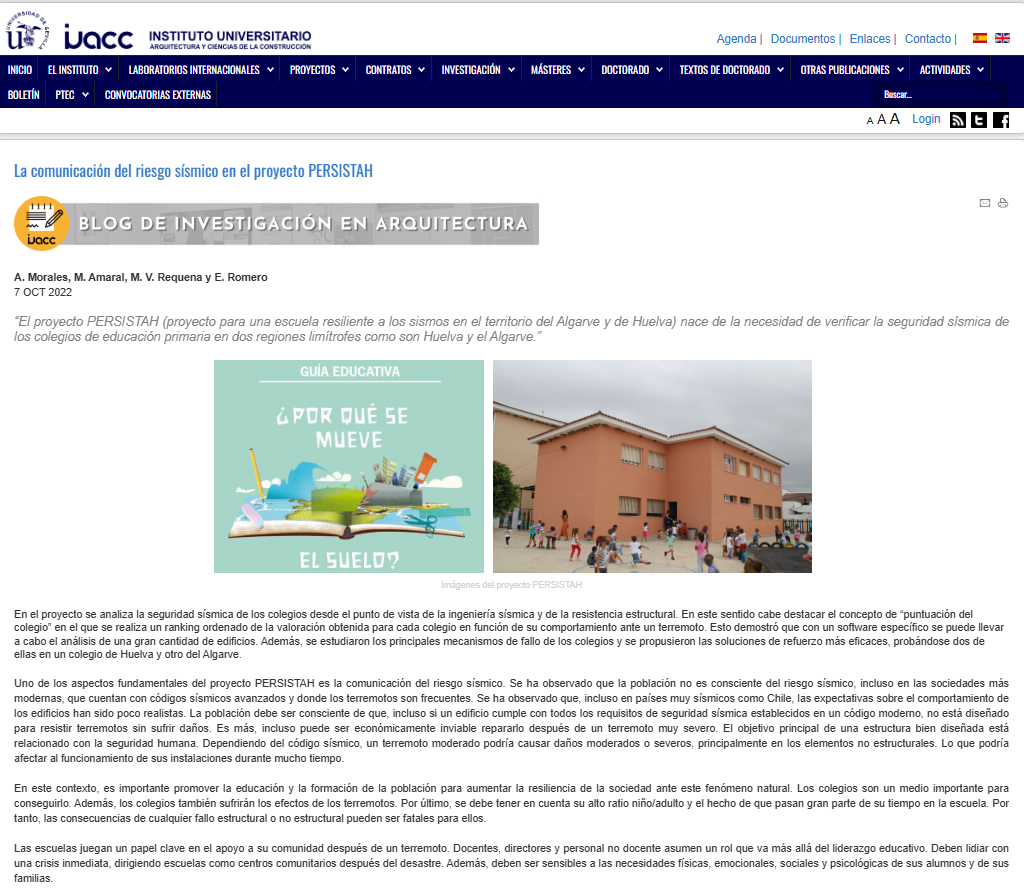
The PERSISTAH Project (Project for a Resilient School to Earthquakes in the Algarve and Huelva Territories) was born out of the need to verify the seismic safety of primary education schools in two bordering regions: Huelva and the Algarve.
The project analyzes the seismic safety of schools from the perspective of seismic engineering and structural resistance. One notable aspect is the concept of a “school score,” in which a ranked list is created based on each school’s expected performance during an earthquake. This showed that, using specific software, it is possible to analyze a large number of buildings. In addition, the main failure mechanisms of the schools were studied, and the most effective reinforcement solutions were proposed, two of which were tested in one school in Huelva and another in the Algarve.
One of the fundamental aspects of the PERSISTAH project is the communication of seismic risk. It has been observed that the population is not generally aware of seismic risk, even in modern societies that have advanced seismic codes and frequent earthquakes. It has also been observed that even in highly seismic countries like Chile, public expectations regarding building performance have been unrealistic. People need to understand that even if a building complies with all the seismic safety requirements of a modern code, it is not designed to withstand earthquakes without damage. In fact, after a very severe earthquake, it might even be economically unfeasible to repair. The main objective of a well-designed structure is related to human safety. Depending on the seismic code, a moderate earthquake may still cause moderate to severe damage, especially to non-structural elements, which could affect the functionality of school facilities for a long period.
In this context, promoting education and public training is crucial to increasing society’s resilience to this natural phenomenon. Schools are an important vehicle for achieving this. Moreover, schools themselves will be affected by earthquakes. Finally, one must consider their high child-to-adult ratio and the fact that children spend much of their time in school. Therefore, the consequences of any structural or non-structural failure could be fatal for them.

Schools play a key role in supporting their community after an earthquake. Teachers, principals, and non-teaching staff take on roles that go beyond educational leadership. They must handle immediate crises, managing schools as community centers in the aftermath of disasters. Additionally, they need to be sensitive to the physical, emotional, social, and psychological needs of their students and their families.
The positive effect of educational programs on children affected by a destructive earthquake is well known. To enable teachers, monitors, and educational technicians to fulfill this role, they need pedagogical and didactic resources for the initial and ongoing training of the educational community. Given the lack of specific material, the PERSISTAH project developed the following educational resources:
-
“Why Does the Ground Move?” (https://dx.doi.org/10.12795/9788447230457)
-
“Practical Guide for an Earthquake-Resilient School” (https://dx.doi.org/10.12795/9788447230518)
All resources were translated and adapted into Spanish, Portuguese, and English. These tools can be used across three types of learning environments (formal, non-formal, and informal), facilitating the connection between curriculum subjects and earthquake risk education in primary school. The goal is to educate teachers and children about the seismic phenomenon and risk reduction in a creative, educational, and playful way. Various activities that encourage both individual and group participation have been integrated. The aim is to develop a culture of safety in children that they can carry into other areas of their daily lives and share with the wider community.
The educational guide “Why Does the Ground Move?” was tested from the beginning of the PERSISTAH project. It was used with preschool students (age 5) and primary school students (ages 6 to 12). Two teacher training courses were also held (https://www.facebook.com/TremeTremeTerramotos/videos/2672745639415530/) in Almonte (Huelva, Spain) and Olhão (Algarve, Portugal). These sessions allowed for testing the methodology and evaluating its practical content.
Recently, during the COVID-19 lockdown, the educational material from “Why Does the Ground Move?” was used in the Portuguese television program #EstudoEmCasa, aimed at students from 1st to 9th grade (https://www.rtp.pt/play/estudoemcasa/p7834/e539122/ciencias-naturais-e-cidadania-7-e-8-anos). The program was broadcast on several Portuguese TV channels.
For more information, visit the project’s website:
👉 https://sway.office.com/BXQDB1gy8KLsIHNZ?ref=Link
Access to the complete article here.