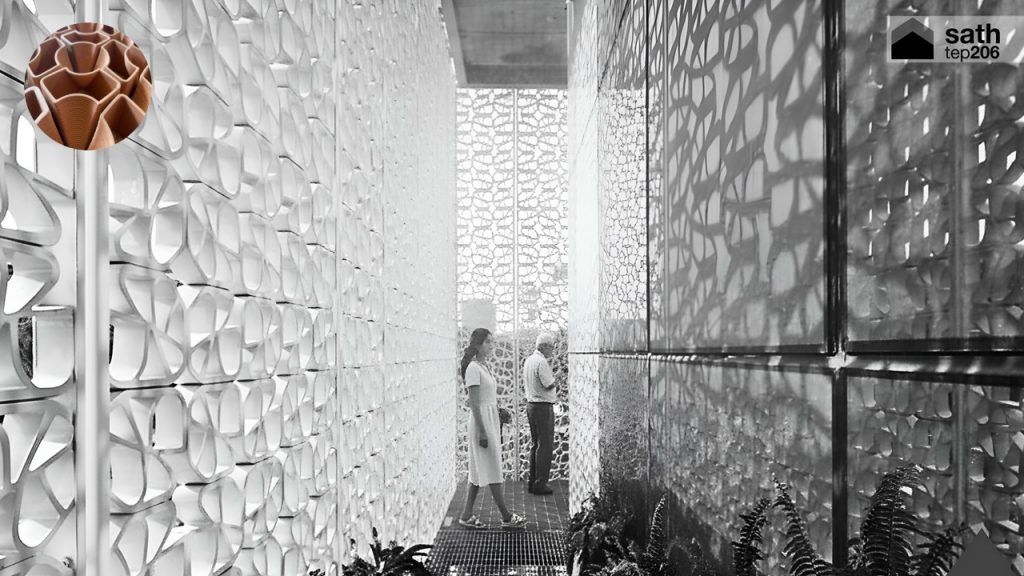
The actions carried out had as their General Objective the transfer of knowledge and specialization acquired by the applicant entity regarding innovative 3D printing methodologies and applications. These were developed specifically based on the requirements and capabilities of the artisanal and industrial ceramic sector, as well as its market challenges linked to bioclimatic architecture applications, heritage conservation, custom or “tailor design,” and neo-artisanal pottery.
To achieve this, the Innovarcilla Technology Center, which over its 20 years of experience has acquired extensive knowledge of the state and challenges of the referenced production sector, and based on previous experiences in 3D Printing through Paste Deposition Modeling (PDM) developed in its Digital Laboratory, designed the proposed action around the following Specific Objectives:
• Specific Objective 1: Establish a control methodology for the preparation and optimization of ceramic pastes for application in 3D printing by PDM. This is based on the analysis, determination, and adjustment of rheological parameters of clay mixtures, which directly influence characteristics such as shape retention and printability.
• Specific Objective 2: Improve the behavior of specifically formulated ceramic pastes in response to challenges presented by 3D printing via PDM, including enhanced interlayer adhesion and increased stability and firmness during piece formation.
• Specific Objective 3: Promote sustainability through the introduction of circular economy strategies by valorizing waste and by-products which, given their high availability in Andalusia, may be viable and advantageous for incorporation into the ceramic pastes under analysis.
• Specific Objective 4: Obtain complex geometric forms which, when applied to 3D printing by PDM, enable the production of pieces that have so far been unfeasible for the ceramic sector, while also posing significant challenges for the selected manufacturing technology.
• Specific Objective 5: Develop and apply new surface treatments and finishes to the formal pieces obtained in SO4, based on the requirements of the pottery, design, architecture, and heritage sectors. The study of potential forms and geometries carried out in SO4 will be expanded at this stage in terms of surface treatments and finishes.
• Specific Objective 6: Transfer to the ceramic sector the knowledge and specialization acquired from the results obtained in SO1 to SO5, and promote the use of the 3D printing methodologies and applications developed in the project. This will be done in accordance with the requirements and capabilities of the artisanal and industrial ceramic sector of Andalusia, responding to market challenges linked to the market segments of interest for GAP 3D.
• Specific Objective 7: Conduct a market analysis focused on identifying new innovative business models linked to 3D printing with clays, assessing the economic viability of commercialization, and creating and consolidating Innovarcilla support tools to facilitate the implementation of 3D printing technologies in the sector after completion of the activity, including a continuity and replicability plan.