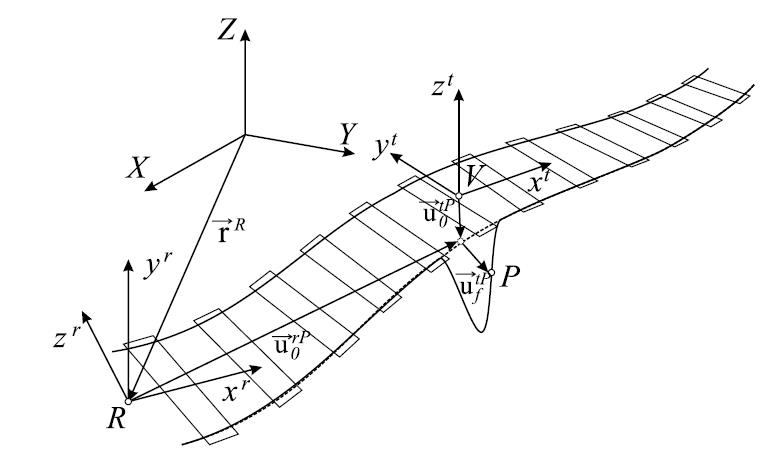
Considering track flexibility in railroad vehicle simulations can lead to improved results. In modeling a railroad vehicle as a multibody system, track flexibility can be incorporated by using the floating frame of reference formulation (FFRF), which describes rail deformations in terms of shape functions defined in the track body frame of reference. However, the FFRF method is subject to two serious shortcomings, namely: it uses unreal track boundary conditions to calculate shape functions and requires a large number of functions to describe deformation. These shortcomings can be circumvented by defining shape functions in the trajectory frame of reference. Based on this notion, a new form of FFRF that can be used to describe the dynamics of long bodies subjected to moving loads (cable cars, zip-lines, elevator guides, pantograph catenary mechanism, etc.) was developed in the Moving Modes Method.
Moving Modes Method (MMM)
Allows to model the track flexibility defining shape functions in the trajectory frame of reference .
MMM with Krylov subspace
The selection of the track modes of deformation is carried out from a finite element model by using Krylov subspaces as the model-order reduction technique.
MMM with discrete supports
Track discrete supports are modelled in this method.