
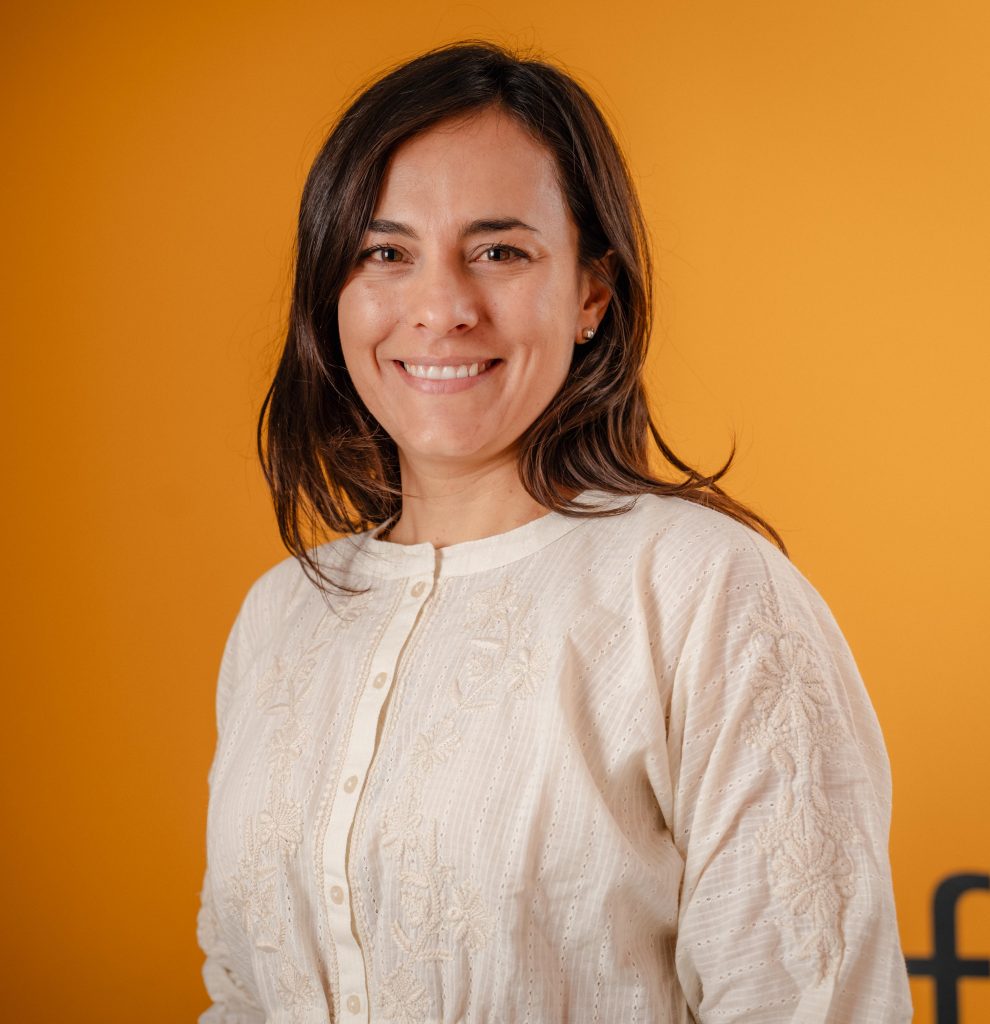
Name: Maria Laura Mascotti
Affiliation: Instituto de Histología y Embriología de Mendoza (IHEM) CONICET
Address: Centro Universitario, M5502JMA, Ciudad, Mendoza, Argentina
ORCID: 0000-0002-5817-4631
Scopus: 26424261800
Short biography:
María Laura Mascotti is a scientific researcher in evolutionary biochemistry. She earned her Ph.D. in Biology from the National University of San Luis (Argentina), with early training in organic synthesis, fungal microbiology, and biotransformations. During her doctoral studies, she was an Erasmus fellow at the University of Groningen (Netherlands), where she specialized in enzymology. Her passion for molecular evolution emerged during her first postdoctoral position at IMIBIO-SL (Argentina), studying flavin-dependent enzymes. She continued her postdoctoral training at leading institutions, including the European Bioinformatics Institute (UK) and the University of Chicago (USA). Between 2020 and 2023, she joined the “Origins of Life (oLife)” program at Groningen, focusing on prebiotic and early-life biochemistry. Currently, Laura is an Associate Researcher at CONICET at IHEM-UNCuyo (Mendoza), where she founded a research group in Evolutionary Biochemistry. She has authored over 30 high-impact publications and actively contributes to teaching, mentoring, peer review, and international scientific networks. Her work integrates molecular evolution, bioinformatics, and enzymatic biochemistry.
University/Company description:
The Institute of Histology and Embryology of Mendoza (IHEM) has been dedicated to biomedical research since its foundation in 1957. IHEM is a dual-affiliation Executive Unit of CONICET and the National University of Cuyo and is part of the Mendoza Scientific and Technological Center (CCT-Mendoza). The Institute is committed to advancing scientific knowledge in biomedical sciences through high-quality, interdisciplinary research, technological innovation, and the transfer of scientific and technological developments with strong societal impact. Its mission emphasizes excellence in research, education, and the training of human resources, while fostering ethical values and critical thinking. The Institute actively supports the incorporation and training of outstanding researchers, contributes to undergraduate and graduate teaching, and strengthens ties with the socio-productive sector. Through scientific dissemination, technology transfer, and outreach activities, IHEM seeks to integrate science into society and contribute to the development of health, education, and innovation at local, national, and international levels.
Facilities, infrastructure & equipment:
IHEM occupies a modern, purpose-built five-story research building on the campus of the National University of Cuyo, designed with state-of-the-art biomedical infrastructure. Its approximately 6,500 m² facility includes advanced laboratories, conditioned areas for optical and electronic microscopy, and dedicated spaces for biological safety and pathogen-free animal housing to support cutting-edge research. Recent expansions added multiple new laboratories, offices, and technical areas such as an omics lab, primary and cell line culture rooms, freezer and equipment storage, and teaching and meeting spaces to enhance scientific collaboration and education. The building’s anti-seismic design minimizes vibrations for sensitive instruments like electron and confocal microscopes, and biosecurity systems with HEPA filtration and controlled pressure spaces ensure safe handling of biological materials. IHEM also supports technological innovation through coworking spaces for biotech startups and provides high-performance computational resources, benefiting from cutting-edge equipment and infrastructure that underpin multidisciplinary biomedical research.
Relevant publications and/or research/innovation products:
- M. L. Mascotti. L. S. Mayorga, D. Masone, An Unconventional Fusion Mechanism at the Origin of Eukaryotic Membranes, J. Phys. Chem. B, 2025, 129, 13141–13152. https://doi.org/10.1021/acs.jpcb.5c05957.
- G. Yang, O. Pecanac, H. Wijma, H. Rozeboom, G. de Gonzalo, M. W. Fraaije, M. L. Mascotti, Evolution of the catalytic mechanism at the dawn of the Baeyer-Villiger monooxygenases, Cell Rep. 2024, 43, 114130. https://doi.org/10.1038/s41467-023-36756-x.
- G. Bailleul, G, Yang, C. R. Nicoll, A. Mattevi. M. W. Fraaije, M. L. Mascotti, Evolution of enzyme functionality in the flavin-containing monooxygenases, Nat. Commun. 2023, 14, 1042. https://doi.org/10.1038/s41467-023-36756-x.
- M. L Mascotti, Resurrecting enzymes by Ancestral Sequence Reconstruction, in Enzyme Engineering: Methods and Protocols, Eds. F. Magnani, C. Marabelli, F. Paradisi, Humana Press, New Jersey, 2022, 111-136. doi:10.1007/978-1-0716-1826-4.