
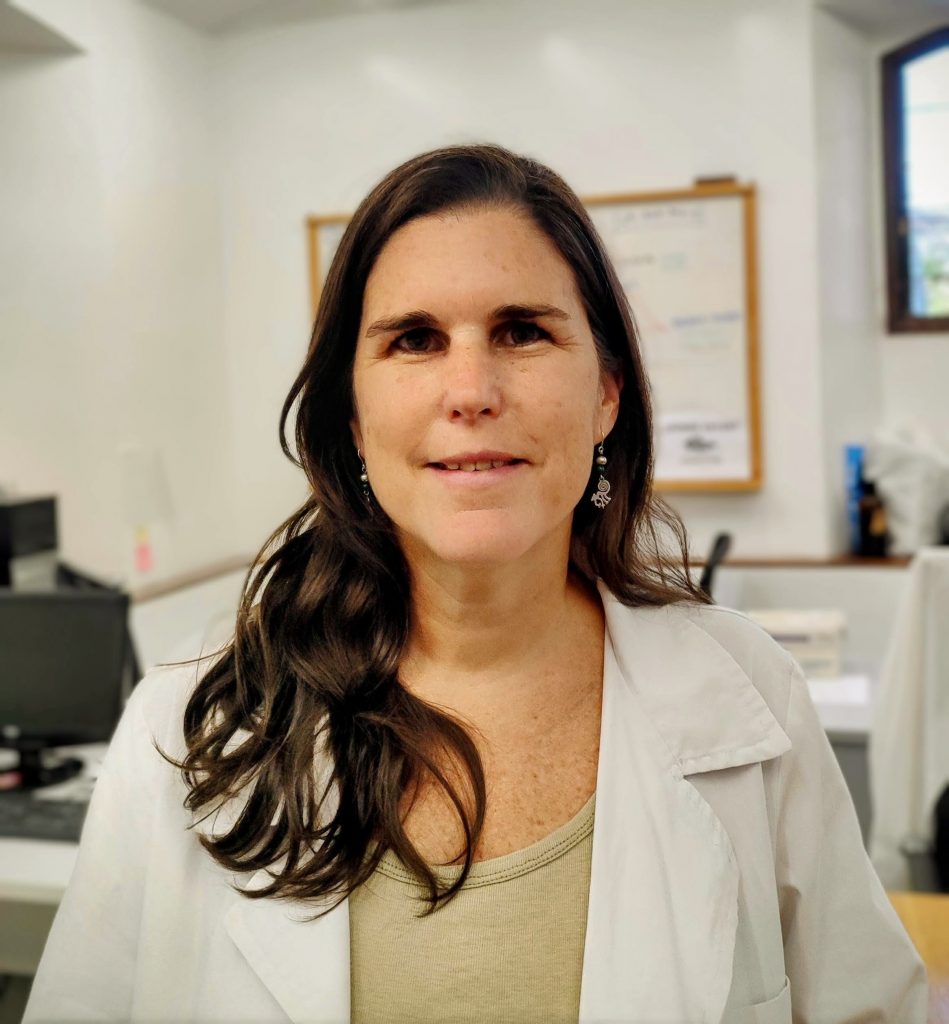
Name: Ana Paola Panizza Scasso
Affiliation: Facultad de Química, Universidad de la República (UdelaR)
Address: General Flores 2124, CP 11800, Montevideo, Uruguay
ORCID: https://orcid.org/0000-0003-4368-8936
Scopus: Scopus Author ID: 22635650400
Short biography:
Dr. Panizza is a researcher and professor at the Microbiology Department of the Faculty of Chemistry, Universidad de la República (UdelaR). She holds a PhD in Chemistry (2013) from UDELAR and a Master’s degree in Advanced Microbiology from the University of Barcelona. Her research expertise focuses on biocatalysis and biotransformations, specifically in the discovery, characterization and optimization of enzymes for biotechnological use. She has worked with diverse biocatalysts, including ϐ-ketoester reductases, lipases, transaminases and iminoreductases. She has experience in protein engineering and in the exploration of genomic and metagenomic data to find enzymes for industrial applications, using both experimental activity-based screening and computational methods. Currently, she leads research lines in bioinformatics applied to biocatalysis, including the use of artificial intelligence for the design of new fluorinases. In addition to her scientific work, Dr. Panizza is actively involved in institutional gender equity initiatives within the scientific community in Uruguay.
University/Company description:
UdelaR is Uruguay’s primary public university and its most significant research institution. Founded in 1849, it accounts for most of the nation’s scientific output, supported by a robust academic community of over 11,500 faculty members and approximately 163,000 students. The university is organized into three main strategic divisions: the Health Sciences Area, the Social and Artistic Area, and the Area of Technologies and Sciences of Nature and Habitat (TyC NyH), comprising 16 specialized faculties with nationwide presence.
The Faculty of Chemistry, part of the TyC NyH area, stands as a leading center for education and research in chemical and biological sciences, with extensive expertise in process development and molecular characterization. Amongst other specialized units, it hosts the Laboratory of Biocatalysis and Biotransformations, which focuses on designing sustainable chemical processes through biological catalysts.
UDELAR maintains a steadfast commitment to academic excellence, social outreach, and the strengthening of local scientific capacity. By addressing global challenges in health, the environment and industry, UDELAR actively fosters international cooperation through an extensive array of regional and global research networks.
Facilities, infrastructure & equipment:
The Laboratory of Biocatalysis and Biotransformations at the Faculty of Chemistry, Universidad de la República, offers a comprehensive environment for integrated research in microbiology, biochemistry, and molecular biology. The facility is equipped with specialized infrastructure for microbial cultivation, strain engineering and enzyme production. Key capabilities include the complete experimental workflow—from gene cloning and protein expression optimization to purification and biochemical characterization. The laboratory also has tools for enzyme immobilization and monitoring enzymatic activity.
Complementing its “wet-lab” capabilities, the research group possesses advanced computational infrastructure for bioinformatics and in silico enzyme design. By integrating experimental and computational approaches, the facility supports the entire biotechnological pipeline: from the initial discovery of novel biocatalysts to the development of sustainable bioprocesses for the pharmaceutical, fine chemical, and biofuel industries.
Relevant publications and/or research/innovation products (3-5 items):
- C. Iglesias, A. Tijman, G. López, M. I. Lapaz, M. J. Pianzzola, P. Panizza, S. Rodríguez Giordano, Identification, Characterization, and In Silico Analysis of New Imine Reductases From Native Streptomyces Genomes. Frontiers Catal. 2021, 1, 785963. DOI: 10.3389/fctls.2021.785963
- Iglesias, P. Panizza, S. Rodríguez Giordano, Identification, Expression and Characterization of an R-ω-Transaminase from Capronia semiimmersa. Appl. Microbiol. Biotechnol. 2017, 101, 5677–5687. DOI: 10.1007/s00253-017-8309-2
- Panizza, N. Syfantou, F. I. J. Pastor, S Rodríguez Giordano, P. Díaz, Acidic Lipase Lip I.3 from a Pseudomonas fluorescens-like strain displays unusual properties and shows activity on secondary alcohols. J. Appl. Microbiol. 2013, 114, 722–732. DOI: 10.1111/jam.12089
- Panizza, S. Cesarini, P. Díaz, S. Rodríguez Giordano, Saturation Mutagenesis in Selected Amino Acids to Shift Pseudomonas sp. Acidic Lipase Lip I.3 Substrate Specificity and Activity. Chem. Commun. 2015, 51, 1330–1333. https://doi.org/10.1039/C4CC08477B