
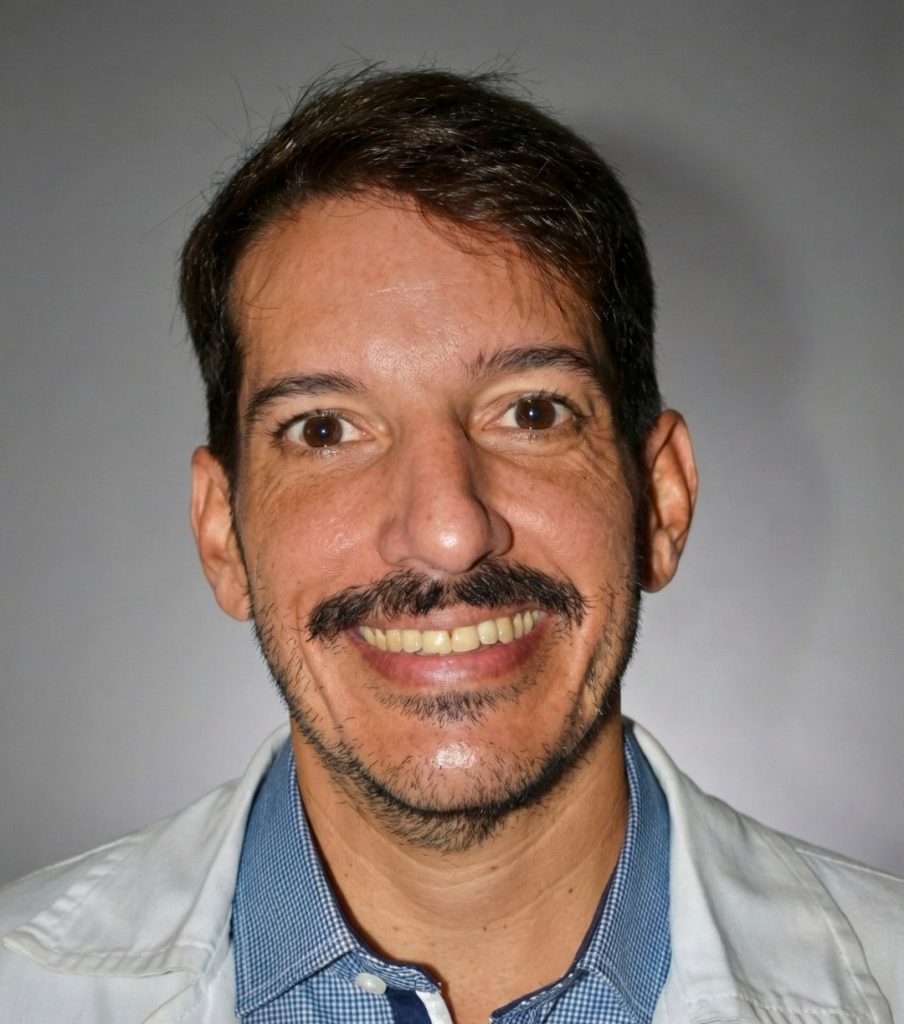
Name: Rodrigo de Souza
Affiliation: Novasynth Technology and Federal University of Rio de Janeiro
Address: R. Hélio de Almeida, S/nº – Cidade Universitária, Ilha do Fundão – RJ, 21941-614
ORCID: https://orcid.org/0000-0002-6422-4025
Short biography:
Prof. Dr. Rodrigo Octavio M. A. de Souza is a leading expert in Organic Chemistry and a pioneer in the implementation of continuous-flow chemistry and chemo-enzymatic processes in Brazil. He holds a PhD from the Federal University of Rio de Janeiro (UFRJ), where he has served as a Professor since 2008. Dr. de Souza’s international career includes research stays at the University of Graz (Austria) and high-level collaborations in Germany as an Alexander von Humboldt Fellow and Alfried Krupp Fellow. His research focuses on enzymatic catalysis, heterogeneous catalysis, and cascade reactions, aimed at developing sustainable synthetic methodologies.
Company description:
With more than ten years of experience on organic synthesis and process development, we use continuous flow technology to produce fine chemicals for pharmaceuticals, cosmetics, food, agro and industrial applications. Our qualified researchers and specialists can create a solution for you needs on chemical synthesis, so that you can focus on what really matters to your business. Our team have a deep understanding on the chemistry of building world-class molecules in which quality, efficiency and affordability are key parameters in order to develop a strong chemical industry.
Facilities, infrastructure & equipment:
– Flow Chemistry Platforms: A suite of continuous-flow reactors, including micro- and meso-scale systems, equipped with high-pressure pumps, thermal controllers, and back-pressure regulators for handling complex synthetic transformations.
– Biocatalysis Hub: Specialized equipment for enzyme immobilization, kinetic studies, and biotransformations, allowing for the seamless integration of biological catalysts into chemical flow streams.
– Analytical Instrumentation: In-house access to high-performance liquid chromatography (HPLC), gas chromatography (GC/MS), and real-time monitoring tools to ensure precise process control and rapid optimization.
– Process Intensification: Capabilities for exploring “enabling technologies,” such as microwave-assisted synthesis and ultrasound-promoted reactions integrated with continuous systems.